How Accurate Is an InBody Scan?
What your body composition results can — and can't — tell you about your progress.
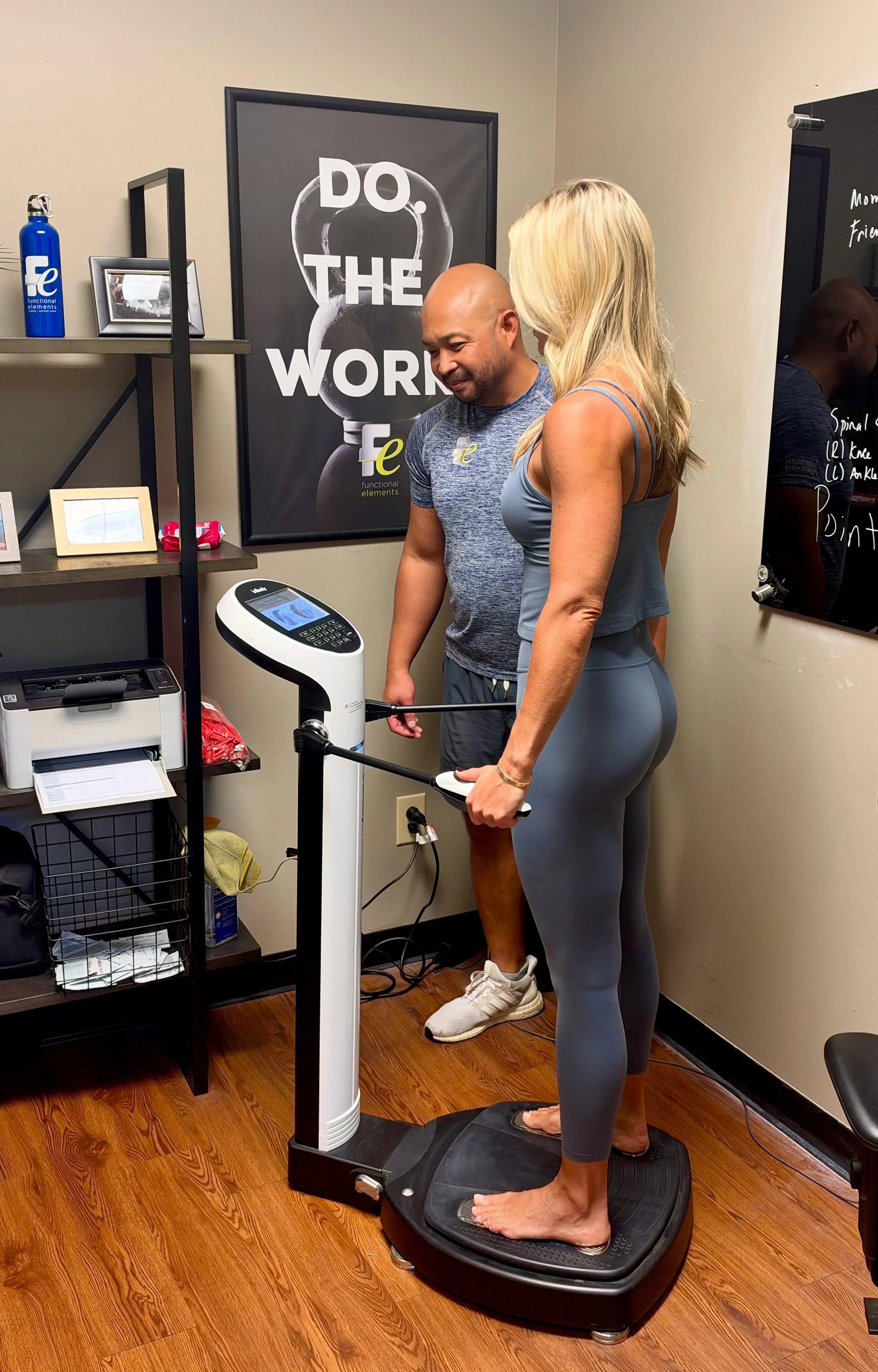
Tony Muyco guides a client through an InBody scan at Functional Elements Training & Nutrition in Creve Coeur, Missouri. The scan helps track changes in body fat, muscle mass and overall body composition as part of a personalized fitness program.
Here at Functional Elements, we love data.
It helps keep us accountable, measure progress and sometimes tell us when something isn't working.
But there's something important we've learned from doing reassessments with clients over the years:
No single measurement tells the whole story.
That's especially true with body composition testing.
At Functional Elements, we use InBody scans to help clients better understand their bodies and track changes in muscle and body fat over time. But one question comes up often:
How accurate is an InBody scan, really?
The short answer: An InBody scan can be a very useful tool for estimating body composition and tracking progress over time, but no single scan should be treated as an absolute measurement of your muscle or body fat.
The real value comes from understanding the numbers — and watching how they trend over time.
What Does an InBody Scan Actually Measure?
An InBody scan uses a technology called bioelectrical impedance analysis, or BIA.
The device sends a very low-level electrical current through the body and measures how that current moves through different tissues. Because water-rich tissues such as muscle conduct electricity differently than fat tissue, InBody uses those measurements to estimate different components of your body composition.
Depending on the model, your results may include:
Skeletal muscle mass: An estimate of the muscle attached to your bones that helps you move, lift and perform everyday activities.
Body fat mass: An estimate of the total amount of fat in your body.
Percent body fat: The estimated percentage of your total body weight that is fat.
Total body water: An estimate of the water contained in your body.
Segmental analysis: Estimates of muscle and fat distribution throughout your arms, legs and trunk.
Visceral fat indicators: Estimates related to fat stored around the abdominal organs.
That's considerably more information than simply knowing what you weigh.
👉 New to InBody? Learn what an InBody scan measures and which numbers actually matter the most.
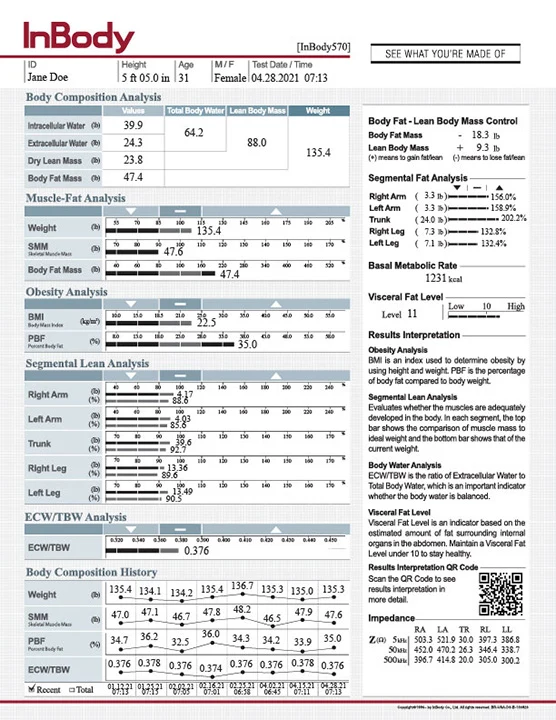
A sample InBody 570 results sheet showing how body composition measurements go beyond weight alone.
So, How Accurate Is an InBody Scan?
The most honest answer is that InBody scans can provide useful and reasonably precise estimates, but they aren't perfect measurements of body composition.
InBody uses multiple electrical frequencies and measures different body segments separately, making it more sophisticated than simpler forms of BIA.
Research comparing InBody with DXA (sometimes called DEXA), another commonly used method of assessing body composition, has found that the two methods can track similarly while still producing different numbers for an individual.
That distinction matters.
Two methods can show a strong relationship without producing identical measurements.
So if your InBody scan estimates your body fat at a certain percentage, another testing method may give you a somewhat different number.
For us, that's not necessarily a problem.
We're generally less interested in finding one supposedly perfect body-fat number than we are in determining whether your muscle and body fat are trending in the right direction over time.
What Can Affect Your InBody Results?
One of the most important things to understand about InBody testing is that it's sensitive to changes in your body's fluid balance.
Temporary changes in hydration can influence your results even when your actual muscle and fat tissue haven't meaningfully changed.
Several things can affect a scan:
Hydration: Being dehydrated or unusually overhydrated can influence your readings.
Food and fluid intake: Eating or drinking shortly before testing can affect your body weight and resulting estimates.
Exercise: Training can temporarily change hydration, body temperature and fluid distribution.
Time of day: Your body's fluid distribution changes throughout the day, meaning a morning scan may differ somewhat from an afternoon scan.
This is why consistent testing conditions matter.
How to Get the Most Accurate InBody Scan Possible
If you're using InBody to monitor progress, the goal isn't to manipulate the scan to produce the "best" numbers.
It's to make each assessment as comparable as possible to the last one.
At Functional Elements, we recommend:
Test at approximately the same time of day each time.
Maintain your normal hydration habits.
Avoid alcohol for 24 hours before your scan.
Avoid drinking liquids for approximately 45 minutes before testing.
Avoid eating for at least three hours before testing.
Avoid exercise for at least three hours before testing; longer may be appropriate after particularly demanding training.
Use the restroom before your scan.
Consistency helps reduce unnecessary variation between tests and gives us a better comparison over time.
We Care More About Trends Than One Scan
This is where we think the real value of InBody testing comes into play.
Let's say you step on the scale and your weight hasn't changed in eight weeks.
You might assume your training and nutrition aren't working.
But what if you've gained muscle while losing body fat?
Your body weight might stay relatively stable even though your body composition has improved. A traditional bathroom scale wouldn't tell you that story.
Now imagine the opposite. Your weight drops several pounds quickly and your next InBody scan shows a decrease in muscle mass.
Does that automatically mean you've lost several pounds of actual muscle tissue?
Not necessarily.
Changes in hydration and stored carbohydrates can influence your measurements, particularly over short periods.
That's why we don't make major training or nutrition decisions based on one unexpected result.
Instead, we look at the bigger picture:
Is skeletal muscle mass generally stable or increasing?
Is body fat trending in the direction that supports your goals?
Are your strength and physical performance improving?
Are you moving better and feeling more capable in everyday life?
When the measurements, your training performance and how you feel all tell a similar story, we have much better information to work with.
Why We Pay So Much Attention to Muscle
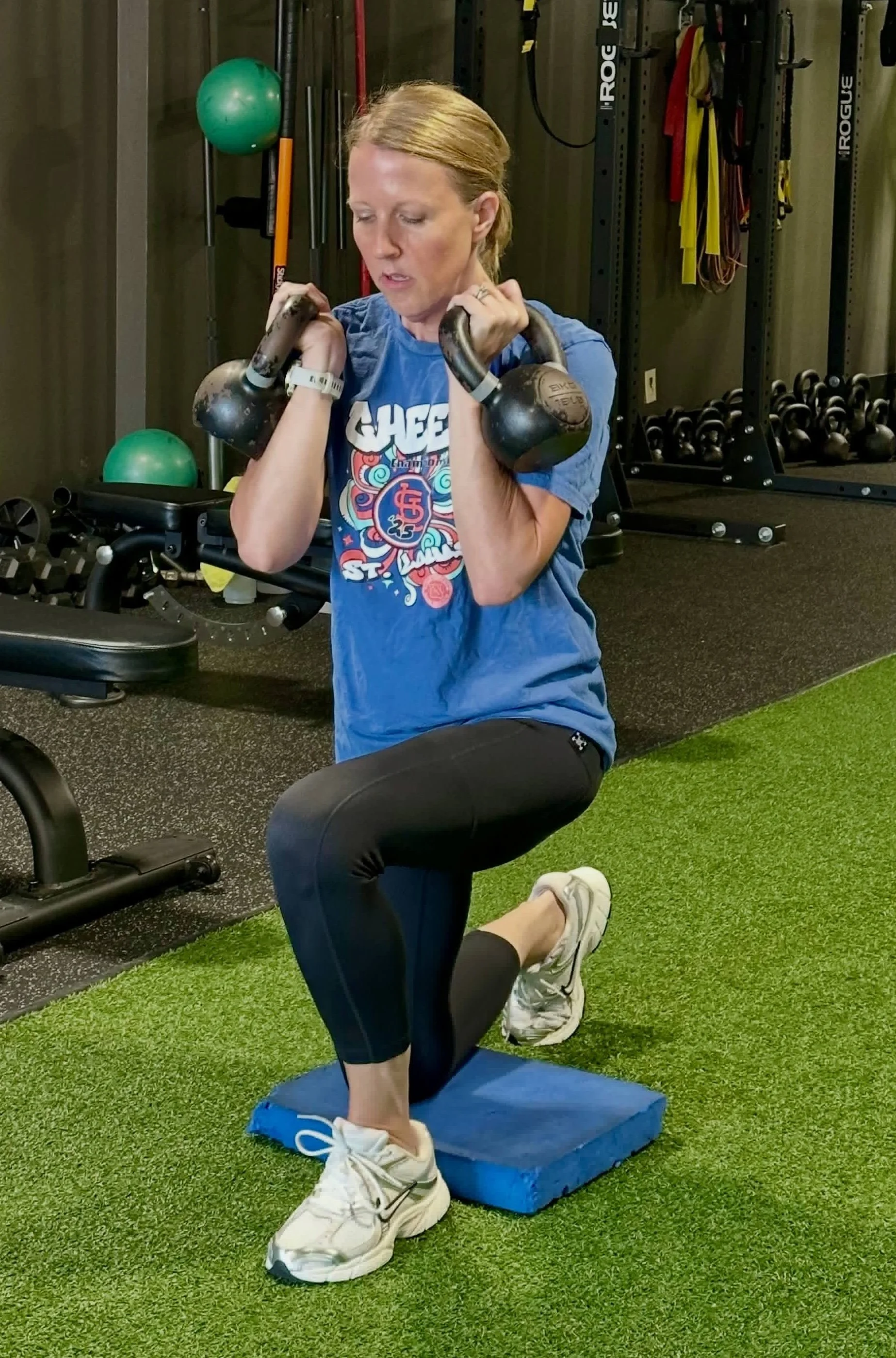
Strength training helps preserve the muscle, strength and physical capability that keep us moving well as we age.
At Functional Elements, we believe building and maintaining muscle is an important part of staying strong and independent as we age.
Muscle supports everyday activities like climbing stairs, carrying groceries, getting up from the floor and maintaining balance.
That's also why we don't want our clients focusing exclusively on losing weight.
If your goal is fat loss, we'd ideally like to see you reduce body fat while preserving as much muscle as possible.
An InBody scan gives us another piece of information to help guide that process.
But it doesn't replace strength testing, movement assessments or conversations about how you're actually feeling and functioning.
It's one piece of a much bigger picture.
The Bottom Line: Use the Data, But Don't Let It Define You
So, how accurate is an InBody scan?
It's a practical tool for estimating body composition and tracking changes when testing conditions are reasonably consistent. Individual results can differ from other testing methods, and short-term changes may reflect fluid shifts rather than actual changes in muscle or body fat.
At Functional Elements, we use InBody results to help guide conversations about training, nutrition and progress. We look for patterns, consider the context and combine the numbers with what we see in the gym and what our clients experience in everyday life.
Because the goal isn't simply to lose weight.
It's to build strength, maintain muscle, move with confidence and stay capable of doing the things you love for as long as possible.
The numbers can help guide the process. The real progress is what those numbers help you accomplish.
Ready to See What Your Progress Actually Looks Like?

Tony Muyco III, CSCS, PPSC, PPSC*KB, CFSC
If you could use a kickstart with your fitness, nutrition and recovery, we can help. It's what we do.
Check out our 14-Day 360° and see how Functional Elements can help you establish a starting point, build a plan around you and track your progress along the way.
And remember...
GIVE YOUR BODY WHAT IT NEEDS, WHEN IT NEEDS IT!
Tony Muyco III, CSCS, PPSC, PPSC*KB, CFSC
Functional Elements Training & Nutrition